
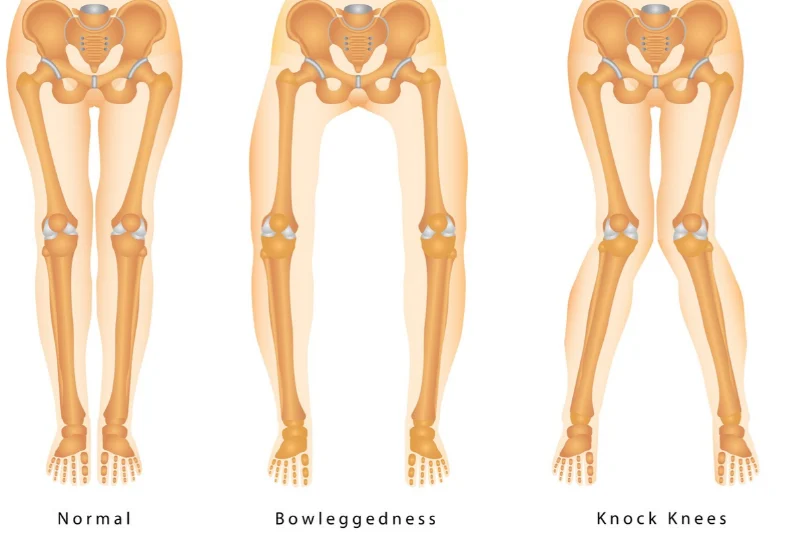
Knock knees and bow legs are easy to tell apart visually, but the difference goes deeper than appearance. Each changes the way weight travels through the legs and across the knee joint.
With knock knees, or genu valgum, the knees angle inward while the ankles remain farther apart. Bow legs, or genu varum, curve in the opposite direction, creating more space between the knees when the feet are together. For adults considering treatment, the important question is not simply which pattern is present. It is where the alignment changes, how much it changes, and whether it is affecting the joints, gait, or daily activities.
At The Height Lengthening Institute in Burbank, Dr. Shahab Mahboubian evaluates these factors before discussing correction. In certain cases, realignment can also be incorporated into a height lengthening treatment plan.
What Happens With Knock Knees?
In a normally aligned leg, weight travels from the hip through the knee toward the ankle along what orthopedic surgeons call the mechanical axis. Knock knees shift that alignment.
The angle can originate in the femur, the tibia, or both. As the knee moves inward, more stress may be transferred toward the outer side of the joint. That difference matters because the location of the deformity helps determine how it should be corrected.
Kneecap tracking can also be affected. Some patients notice pain at the front of the knee, instability, or difficulty with activities that load the joint.
Knock knees can develop for several reasons, including:
- Developmental skeletal variations
- Previous growth plate injuries
- Conditions that affect bone development or mineralization
- Trauma that changes the alignment of a bone
Not every adult with knock knees has pain or progressive joint problems. When symptoms do occur, however, the altered alignment may affect walking mechanics and contribute to uneven joint loading over time.
Also Read: Knock Knee Deformity Symptoms, Causes, and Treatments
How Are Bow Legs Different?
Bow legs shift the mechanical axis in the opposite direction. Instead of angling inward, the legs curve outward, increasing loading through the inner side of the knee.
That extra stress may affect the medial compartment, including the cartilage and meniscus. Some patients first notice discomfort along the inside of the knee. Others become aware of changes in the way they walk or symptoms at the hip or ankle as the body compensates for the alignment.
Possible causes include Blount’s disease, certain bone dysplasias, and fractures that healed in a misaligned position.
This is one reason an orthopedic evaluation looks beyond the shape of the knees. The hip, knee, and ankle work together. A change in one part of that chain can influence movement elsewhere.
Knock Knees vs. Bow Legs at a Glance
|
Feature |
Knock Knees |
Bow Legs |
|
Medical Term |
Genu varum |
|
|
Appearance |
Knees angle inward |
Legs curve outward |
|
Area That May See More Stress |
Outer side of the knee |
Inner side of the knee |
|
Possible Effects |
Patellar tracking problems, altered gait, lateral joint stress |
Medial joint stress, altered gait, compensatory symptoms |
|
Potential Surgical Correction |
Femoral or tibial osteotomy |
Tibial or femoral osteotomy |
|
Height Lengthening |
May be combined with realignment in select cases |
May be combined with realignment in select cases |
The table shows the basic distinction, but it does not determine treatment. Two patients can have a similar-looking leg shape and still need very different approaches depending on where the deformity originates.
Also Read: Effective Diagnosis and Treatment of Genu Varus and Genu Valgus
When Does Realignment Surgery Make Sense?
When a structural deformity is significant enough to warrant surgical correction, an osteotomy may be considered. During an osteotomy, the surgeon cuts and repositions the femur or tibia to change the leg’s alignment.
The location of that correction is important. Before surgery, Dr. Mahboubian evaluates where the angulation begins, the condition of the knee, and the mechanical axis of the entire leg. The goal is to create a more appropriate alignment and improve how weight-bearing forces pass through the knee.
Surgery is not determined by appearance alone. Symptoms, joint health, bone quality, the degree of deformity, and the patient’s goals all factor into the decision.
Can Realignment and Height Lengthening Be Done Together?
For some patients, yes. Someone considering height lengthening may also have knock-knee or bow-leg alignment that needs to be addressed as part of the surgical plan.
Internal motorized nails, such as the PRECICE system, allow the bone to be lengthened gradually after surgery. In selected cases, the treatment plan can account for both length and alignment rather than treating them as unrelated concerns.
That does not mean combined treatment is appropriate for every patient. The amount of correction and lengthening that can be considered depends on anatomy, bone health, existing alignment, and the goals established during surgical planning.
Limb Alignment Care With Dr. Shahab Mahboubian
Dr. Shahab Mahboubian, DO, MPH, is a board-certified orthopedic specialist who completed fellowship training in limb lengthening and deformity correction at the Hospital for Special Surgery in New York. His practice includes knock knee and bow leg correction, limb length discrepancies, height lengthening, and complex limb deformities.
At The Height Lengthening Institute in Burbank, the evaluation focuses on understanding the deformity before deciding how, or whether, it should be corrected. Recovery planning also includes rehabilitation, since restoring motion, strength, and walking mechanics is an important part of healing after realignment or lengthening surgery.
Also Read: Athletes With Knock Knees: Learn How Surgical Correction Can Help You
Frequently Asked Questions
What Is the Main Difference Between Knock Knees and Bow Legs?
Knock knees angle inward, while bow legs curve outward. The difference also changes where stress may be concentrated across the knee, with valgus alignment affecting the outer side and varus alignment affecting the inner side.
Can Knock Knees or Bow Legs Cause Arthritis?
Abnormal alignment can contribute to uneven joint loading, which may increase wear over time. It does not mean every patient will develop arthritis. Existing cartilage health, the severity of the deformity, age, activity, and other factors influence long-term joint health.
How Does an Osteotomy Correct Leg Alignment?
An osteotomy changes the position of the femur or tibia so the leg has a more appropriate mechanical axis. Where the bone is corrected depends on the location and pattern of the deformity.
Can I Correct Bow Legs or Knock Knees and Gain Height at the Same Time?
It may be possible in select cases. If height lengthening is also a goal, Dr. Mahboubian can determine whether alignment correction and lengthening can be incorporated into the same treatment plan.
Is Leg Realignment Surgery Permanent?
The bone is intended to heal in its corrected position. Long-term joint health still depends on factors such as the underlying condition, cartilage health, activity, and individual healing.
How Do I Know Whether My Leg Alignment Needs Treatment?
Appearance alone does not answer that question. An orthopedic evaluation can assess where the deformity originates, how severe it is, whether it is affecting your joints or gait, and whether treatment would offer a meaningful benefit.
Considering Knock Knee or Bow Leg Correction?
If you are concerned about your leg alignment, the first step is understanding what is actually happening from the hip through the knee and ankle. Dr. Shahab Mahboubian can evaluate the deformity, discuss how it may be affecting your movement and joint health, and determine whether realignment, height lengthening, or another approach makes sense for your goals.